
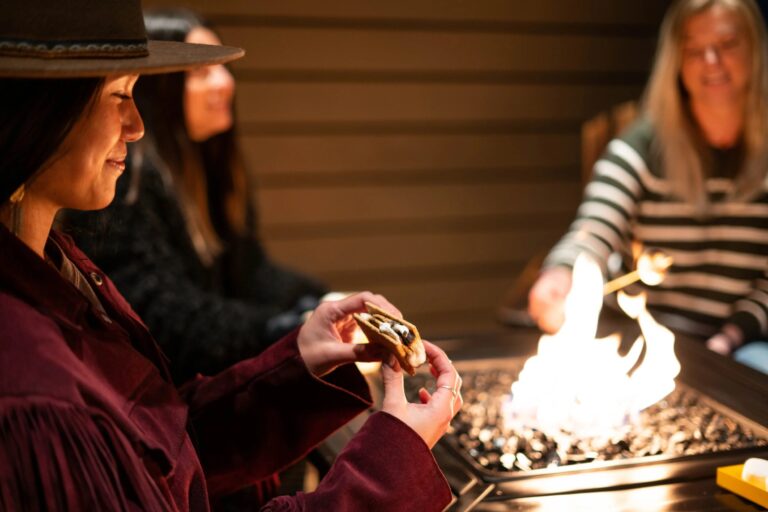
There are two kinds of s’mores: the ones that happen to you, and the ones you manufacture with intent. This post is about the latter—an unnecessarily technical protocol for producing a consistently excellent s’more under imperfect field conditions, with controlled heat flux, predictable rheology, and minimal graham cracker structural failure.
0. Design Requirements and Success Metrics
Define what “perfect” means before you start lighting fires like an amateur.
Functional requirements
- Marshmallow core: partially molten, not hollowed into an ash cavern.
- Outer crust: thin Maillard/pyrolysis shell with low soot loading.
- Chocolate: softened to a viscoelastic state (spreadable), not liquefied into a drip vector.
- Crackers: intact load-bearing structure; no catastrophic shear at bite initiation.
Key performance indicators
- Adhesion coefficient between marshmallow and chocolate: high enough to prevent delamination.
- Thermal gradient across marshmallow radius: controlled (hot shell, warm core).
- Chocolate glass transition proximity: warm enough to deform, cool enough to stay put.
- Cracker compressive strength retention: maximize by minimizing pre-assembly thermal exposure and humidity uptake.
1. Bill of Materials and Component Selection
1.1 Graham crackers (structural substrate)
You want a cracker that behaves like an engineered laminate, not a damp wafer.
- Favor crackers with lower ambient humidity exposure. Store in a sealed container. The graham cracker is a hygroscopic regret sponge.
- Full sheets split into halves provide consistent geometry and better load distribution than random fragments scavenged from a crushed sleeve.
1.2 Chocolate (phase-change interface layer)
Standard milk chocolate works because it softens readily; dark chocolate offers higher thermal stability but demands more energy input.
- Use one to two segments per s’more, depending on chocolate thickness.
- Optional: pre-score or choose chocolate with thin cross-section to reduce time-to-soften.
1.3 Marshmallow (the compliant thermal actuator)
Uniform size matters. Jumbo marshmallows push you toward long cook times and higher cracker failure rates.
- Standard cylindrical marshmallows provide predictable surface-area-to-volume ratio.
2. Heat Source Characterization
S’mores live and die by thermal control. Your “fire” is a chaotic radiant + convective source with variable emissivity, airflow, and fuel composition.
2.1 The correct zone: “coal-adjacent, flame-avoiding”
Open flame is a high-variance heat source that deposits soot and causes exterior runaway heating.
- Target glowing embers or coals: more stable radiant output, less particulate, fewer spikes in local temperature.
2.2 Stick selection (marshmallow mounting hardware)
- Use a stick that is dry, rigid, and non-resinous. Resin = aromatics = off-flavors + smoke adhesion.
- Tip geometry should allow centered impalement to reduce torque-induced rotation wobble.
3. The Marshmallow Thermal Profile: Controlled Melting Without Catastrophic Shell Failure
3.1 Mounting and alignment
Impalement depth should be enough to resist torsion but not so deep it becomes a heat sink.
- Aim for centerline mounting through the marshmallow’s axis.
3.2 Rotational control: manual closed-loop feedback
S’more manufacturing is essentially slow-rotation surface toasting to achieve uniform crust formation.
- Rotate at a constant angular velocity (slow). You are minimizing local overheating and keeping the shell thickness consistent.
- Keep the marshmallow outside the flame envelope. Use radiant energy, not direct combustion contact.
3.3 Doneness criteria: shell integrity and compliance
A marshmallow is “ready” when:
- The exterior has a thin browned crust.
- The marshmallow exhibits bulk compliance (it deforms slightly under gentle pressure from gravity).
- It has not ballooned into a fragile hollow sphere (a sign of shell overcooking and steam expansion).
Advanced note: The core should be warm enough to reduce viscosity but not so hot that the whole thing becomes a Newtonian collapse event.
4. Chocolate Softening Strategy: Reduce Assembly Friction
Chocolate softens slower than marshmallow under camp conditions because it’s insulated by its own thickness and dissipates heat differently.
4.1 Passive preheating
Place chocolate on graham cracker and keep it near (not over) the fire—warm ambient zone, not direct radiant blast.
- The goal is to bring chocolate closer to pliability without melting it into an uncontrolled flow.
4.2 Contact-melt tactic
The marshmallow is your thermal transfer device. Use it.
5. Assembly Protocol: Minimizing Shear and Maximizing Bonding
5.1 Staging
- Lay out: cracker base + chocolate, cracker top in reach.
- Ensure crackers remain cool and dry. Warm crackers are weaker; humid crackers are worse.
5.2 Transfer
Immediately after marshmallow reaches target state:
- Place marshmallow onto chocolate (centered).
- Apply top cracker.
- Compress gently using even pressure, keeping alignment.
5.3 Dwell time (thermal equalization phase)
This is where most people fail by biting immediately and creating a thermal + mechanical disaster.
- Hold for 5–15 seconds (depending on ambient temperature and chocolate thickness).
- Purpose:
- Marshmallow heat conducts into chocolate, increasing spreadability.
- Bond line stabilizes.
- Internal pressure equalizes, reducing blowout on first bite.
6. Bite Mechanics: Preventing Structural Collapse
The s’more is a brittle-ductile-brittle sandwich. Your bite is a destructive test.
- Bite near the center to avoid lever-arm torques that snap the cracker.
- Use a slow bite initiation to allow stress redistribution rather than instantaneous fracture.
- If your chocolate is still rigid, you skipped dwell time.
7. Failure Modes and Root Cause Analysis
7.1 Marshmallow incineration (black exterior, raw interior)
Cause: direct flame exposure, insufficient rotation control.
Mitigation: move to ember zone, slow rotation.
7.2 Hollow marshmallow blowout
Cause: shell overcooked; internal steam expansion forms void; shell collapses on compression.
Mitigation: reduce heat intensity; stop toasting earlier; aim for thinner crust.
7.3 Chocolate shattering / delamination
Cause: chocolate below softening threshold; poor wetting with marshmallow.
Mitigation: prewarm chocolate; increase dwell time; use thinner chocolate segments.
7.4 Graham cracker fracture
Cause: humidity uptake, excessive compression, misalignment leading to uneven load.
Mitigation: keep crackers sealed; compress gently; center your stack.
8. Optional Enhancements (Strictly Non-Essential, Therefore Mandatory)
- Thermal buffer layer: a thin smear of peanut butter can improve adhesion and reduce chocolate brittleness, but it changes system flavor dynamics significantly.
- Geometry optimization: use two smaller marshmallows instead of one jumbo to reduce thermal gradients and improve symmetry.
- Environmental control: wind increases convective cooling and destabilizes heating; use your body as a windbreak like a responsible field engineer.
9. Reference Implementation: The “Repeatable Perfect S’more” Checklist
- Build fire, wait for a stable coal bed.
- Keep crackers sealed until assembly.
- Stage chocolate on base cracker; optionally prewarm nearby.
- Toast marshmallow over embers with slow, constant rotation.
- Transfer marshmallow to chocolate; cap with top cracker.
- Gentle compression; 5–15 second dwell.
- Bite with centered, controlled force.
If you follow this protocol, you’ll stop “making s’mores” and start producing them—with predictable texture, controlled melt, and minimal collateral cracker damage. That’s the difference between campfire luck and campfire engineering.